The High Cost of "Good Enough"
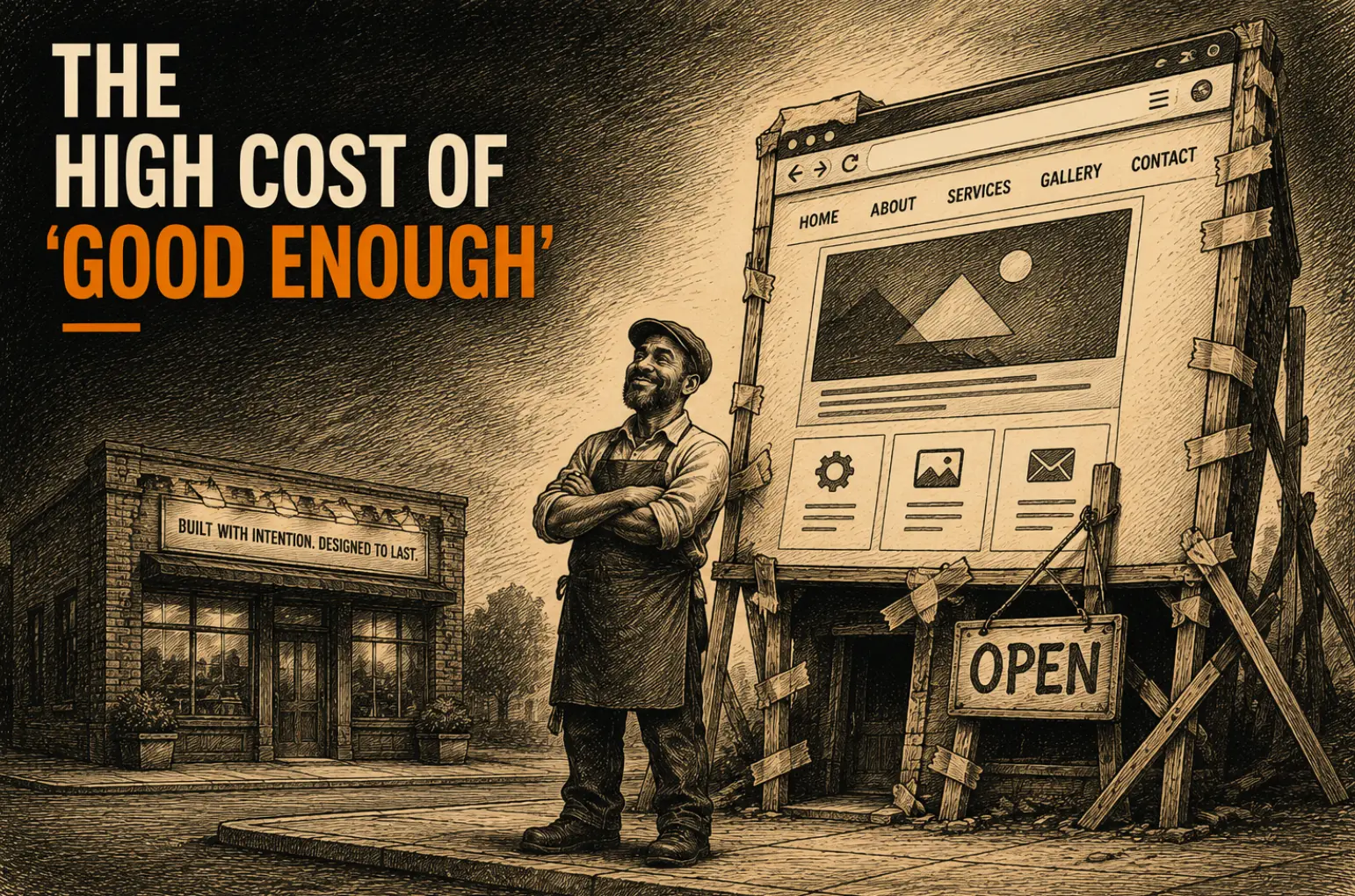
I see it all the time. A business owner needed a website fast, didn't have much of a budget, and a DIY builder or an AI tool promised they could have one up in an afternoon. So they did.
And for a while, it looks fine. That's the whole appeal — speed, low cost, something live today instead of waiting weeks for someone to build it right.
But "good enough" has a way of becoming expensive later, just quietly, in ways that don't show up until you're already stuck with them.
The trade you don't see coming
DIY and AI builders are genuinely good at getting something online fast. What they're not built for is what comes after — growth, change, the actual life of a business.
A site built to launch quickly usually wasn't built to scale. Add more products, more pages, more traffic, and the platform that made everything easy in month one starts fighting you in month twelve. What was fast becomes the very thing slowing you down.
Performance is the same story. These sites often run fine on day one and get sluggish over time — more plugins stacked on, more bloated templates, nothing underneath built to hold weight long-term.
Everyone's site starts to look the same
This is the one that costs a business the most without them realizing it: the templates. DIY and AI tools work from a limited set of designs, and thousands of other businesses are pulling from the same pool. Your site ends up looking like a dozen others in your industry, because the tool only had so many designs to pull from in the first place.
It has to accommodate a plumber, a bakery, and a law firm with the same layout, so it settles for whatever doesn't actively break for any of them. Custom design starts from the opposite direction — what does this specific business actually need, what does its audience actually respond to — and builds toward that instead of away from generic conflict.
A website is often the first impression a potential customer gets of your business. If it looks like everyone else's, it's not doing the one thing it's actually there to do — show people why you're different.
And when something breaks, you're on your own
This is the part nobody thinks about until it happens. Something goes wrong — the layout breaks, a form stops working, the site goes down — and there's no one to call. Community forums, generic help articles, a chatbot that loops you back to the same three answers that don't solve anything. No one who actually knows your business, your goals, or what you were trying to build in the first place.
Here's what I've seen more than once: a business owner spends less up front on a DIY builder or an automatically generated AI site, and ends up spending more later — either paying someone to untangle and rebuild what's there, or losing customers and credibility while the site quietly underperforms in the background.
Fixing a site that wasn't built to last almost always costs more than building it right from the start. DIY tools are genuinely good at speed. They were never built to carry a business past its first year.